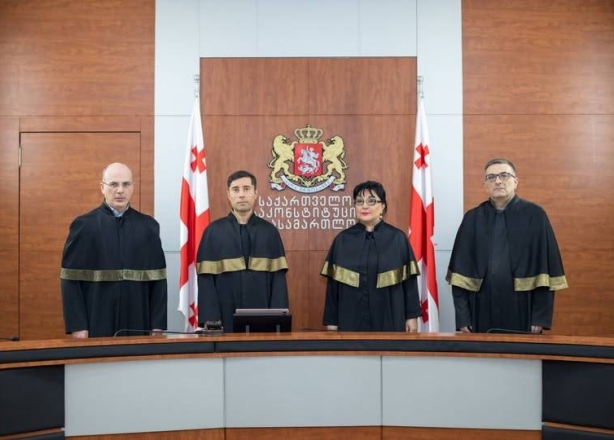

On April 29, 2026, the First Board of the Constitutional Court of Georgia ruled to uphold the Constitutional Claim №.1794 ("Public Defender of Georgia v. the Parliament of Georgia").
On April 29, 2026, the First Board of the Constitutional Court of Georgia ruled to uphold the Constitutional Claim №.1794 ("Public Defender of Georgia v. the Parliament of Georgia").
On April 29, 2026, the First Board of the Constitutional Court of Georgia ruled to uphold the Constitutional Claim №.1794 ("Public Defender of Georgia v. the Parliament of Georgia").
The disputed norms define the grounds for compulsory psychiatric treatment, the authority of the court hearing criminal cases to use compulsory psychiatric treatment, and establish the period for compulsory psychiatric treatment.
The Claimant submits that, within the period of compulsory psychiatric treatment, under the applicable legislative framework, the patient is unable to benefit from adequate procedural safeguards to balance the intensive restriction of their rights. As a result, a person may be kept in a psychiatric institution even when he/she no longer requires treatment. This, in turn, leads to violation of human dignity and establishes discriminatory treatment compared to persons subjected to involuntary psychiatric treatment.
According to the Respondent, the procedure governing the compulsory psychiatric treatment provides the possibility of individual assessment, as well as timely review and termination of the need for treatment. Therefore, it cannot be regarded as an institution that violates human dignity. At the same time, persons subjected to compulsory treatment, taking into account the heightened risk they pose, cannot be considered to be substantially equal to persons subjected to involuntary treatment.
The Constitutional Court, taking into account the nature of compulsory psychiatric treatment, the intensity of its interference with fundamental human rights and freedoms, and the degree of institutional control by the State, held that, in the absence of procedural guarantees necessary for protecting the patient's legal status, the duration of such treatment may reach the threshold of inhuman or degrading treatment prohibited under Paragraph 2 of Article 9 of the Constitution of Georgia, specifically where the treatment is not based on the actual needs of the individual's mental condition and is carried out when there is no longer an objective necessity for the continuation of treatment.
The Constitutional Court emphasized the necessity of the existence of procedural safeguards, which, taken together, must ensure the prevention of the unjustified prolongation of compulsory treatment. The Constitutional Court identified, as such necessary legal safeguards, the obligation to provide for the regular, reasonably periodic, objective and impartial review of the necessity of compulsory psychiatric treatment, the individual’s right to initiate a review of the need for such treatment, and the existence of adequate judicial control.
The Constitutional Court held that, under the existing legislative framework, the determination of whether to continue compulsory psychiatric treatment remains in fact resolved only within the framework of a single medical institution, without effective judicial control and the meaningful involvement of appointed experts. The Court held, that this creates a risk of unjustified prolongation of compulsory treatment. The Court considered, that the legislation governing the legal relationship in question does not contain sufficient guarantees and effective mechanisms of legal response that would actually and effectively ensure the protection of a person from unjustified prolongation of compulsory treatment. Accordingly, the disputed norms were declared unconstitutional with respect to Paragraph 2 of Article 9 of the Constitution of Georgia.
In addition, the Constitutional Court held that in the given case, the disputed norms no longer required an independent assessment with respect to the right to equality. At the same time, the Court postponed the declaration of the disputed norms as invalid until November 1, 2026, in order to grant the legislator a reasonable period to adopt the legislative amendments necessary for the implementation of the decision.
Subject of the Dispute: Constitutionality of the first and second sentences of Section 2(1) of Article 191 of the Criminal Procedure Code of Georgia and Paragraph 1 of Article 22(1) of the Law of Georgia "On Psychiatric Care" with respect to Paragraph 2 of Article 9, and Paragraph 1 of Article 11 of the Constitution of Georgia.