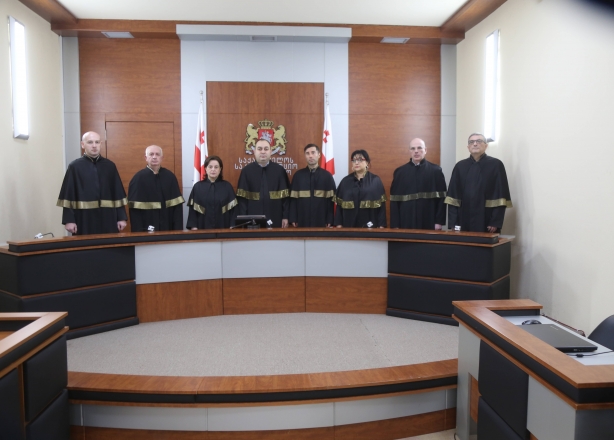
On March 26, 2026, the Plenum of the Constitutional Court of Georgia adopted a decision on the case - of the constitutional submissions №1914, № 1920, №1921, №1922, №1928 and №1938 of Tetri
On March 26, 2026, the Plenum of the Constitutional Court of Georgia adopted a decision on the case - of the constitutional submissions №1914, № 1920, №1921, №1922, №1928 and №1938 of Tetri
On March 26, 2026, the Plenum of the Constitutional Court of Georgia adopted a decision on the case of the constitutional submissions of the Tetritskaro District Court on the constitutionality of Part 11 of the Note to Article 451 of the Code of Administrative Offenses of Georgia and the first sentence of Paragraph 11 of Article 3 of the Law of Georgia “On Combating Drug-Related Crime” (the Constitutional Submissions №1914, № 1920, №1921, №1922, №1928 and №1938).
According to the appealed regulations, committing an offence under Part 1 of Article 451 of the Code of Administrative Offences (which involves the illegal purchase, storage, transportation, and/or transfer of cannabis or marijuana in a small quantity) entails mandatory banning from driving for a period of 3 years, although deprivation of the rights to engage in pedagogical and educational activities, to work in public service, and to manufacture, purchase, store, and carry weapons for a period of 5 years. According to the position of the authors of the submissions, the measures envisaged by the disputed norms do not correspond to the severity of the act considered a violation of the law and the dangers arising or expected from it. Moreover, their automatic and absolutely determinate nature excludes the court from assessing the individual circumstances in a particular case.
According to the Constitutional Court, the legitimate objectives pursued by the disputed measures serve to protect various, distinct yet interrelated private and public interests across different areas. The restriction of the right to drive a vehicle is intended to protect the life and health of third parties, as driving poses an increased risk and requires constant vigilance and strict compliance with legal regulations. Restricting rights related to weapons serve to prevent violence and ensure the stability of the legal regime implemented on the basis of state permits in the area of weapons circulation.
Restrictions on activities in pedagogical and educational institutions aim to protect the educational environment from the potential distribution and influence of narcotic substances, as well as to ensure the safety of the educational setting and safeguard public interests. Restrictions on the right to engage in public service activities are intended to ensure the effective functioning of state institutions, maintain public trust in public administration, and ensure the protection of legal order in the exercise of public functions.
In assessing proportionality, the Constitutional Court took into account, on the one hand, the intensity of the restriction and its impact on a person’s self-realization and professional activities, and, on the other hand, the individual and public interests that the appealed provisions are intended to protect.
The court noted that the aforementioned measures apply to areas related to activities involving increased risk and requiring special caution and responsibility. The court indicated that although restrictive measures impact many aspects of social life, it considered that they are aimed at regulating high-risk areas where ensuring safety is of particular importance. Additionally, the court emphasized that the deprivation of rights is a temporary measure, in effect for a predetermined period, and does not result in final deprivation of rights, thereby mitigating the intensity of the restriction. As for their mandatory application, it is justified as it ensures and increases the effectiveness of protecting individual rights and public order. According to the Constitutional Court, when a person’s conduct creates a real and evident risk to human life, health, or public safety, the State is granted broader discretion in regulating the relevant area.
The Constitutional Court of Georgia concluded that, in view of the severity of the danger averted and the potential harm, the mandatory deprivation of rights under the disputed norms does not constitute a clearly disproportionate sanction. Accordingly, the appealed normative content of Part 11 of the Note to Article 45¹ of the Code of Administrative Offenses of Georgia and the first sentence of Article 3, paragraph 11 of the Law of Georgia “On Combating Drug-Related Crime” does not contradict Article 9, paragraph 2 of the Constitution of Georgia.
A dissenting opinion of the justices of the Constitutional Court Mr. Giorgi Kverenchkhiladze and Mr. Teimuraz Tughushi is attached to the judgement.
Subject of the Dispute: Constitutionality of Part 11 of the Note to Article 45¹ of the Code of Administrative Offenses of Georgia and the first sentence of Article 3, Paragraph 11 of the Law of Georgia “On Combating Drug-Related Crime” with respect to Article 9, Paragraph 2 of the Constitution of Georgia.